Small Projects
Using AI for rapid prototyping
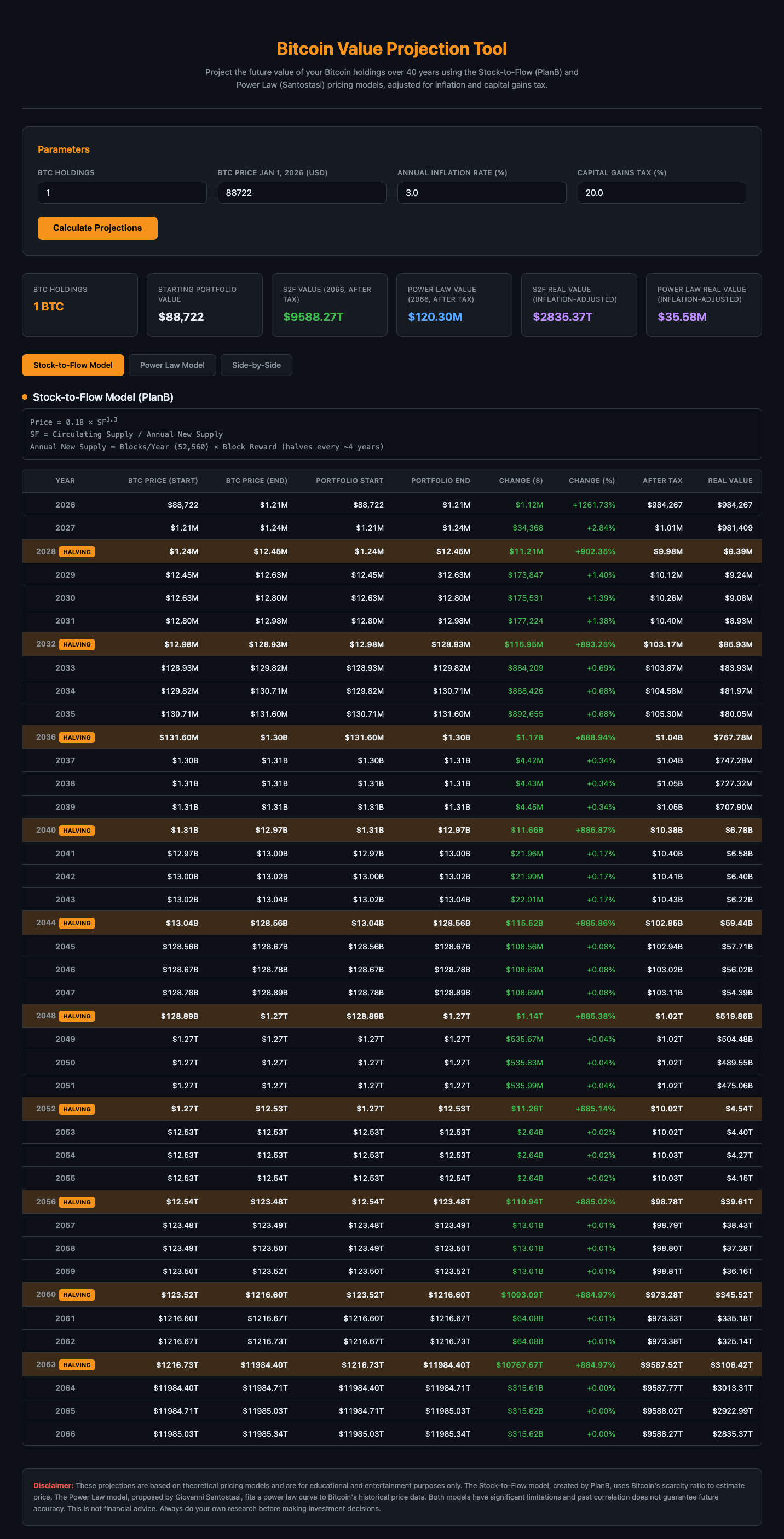
Bitcoin Value Projection Calculator
using Stock-to-Flow and Power Law pricing models
2026
LLM used: Anthropic Claude - Opus 4.6
Features:
-
Two pricing models calculated from their published formulas:
- Stock-to-Flow (PlanB): Price = 0.18 × SF^3.3, where SF = circulating supply / annual new supply. This accounts for Bitcoin's halving schedule (block rewards halving roughly every 4 years). Note that S2F produces very aggressive projections — it's been widely criticized for overestimating since 2021.
- Power Law (Santostasi): Price = 10^(-17) × D^5.82, where D = days since the Genesis Block (Jan 3, 2009). This model tends to give more moderate long-term projections.
- Input fields for BTC holdings, starting price (defaulted to $88,722 — the Jan 1, 2026 closing price), annual inflation rate, and capital gains tax rate
- Three table views: S2F only, Power Law only, and a side-by-side comparison
- Each table shows year, BTC price at start and end of year, portfolio value, dollar and percentage change, after-tax value, and inflation-adjusted real value
- Halving years are highlighted with a badge
- Summary cards at the top show your key figures at a glance
- Auto-calculates on page load
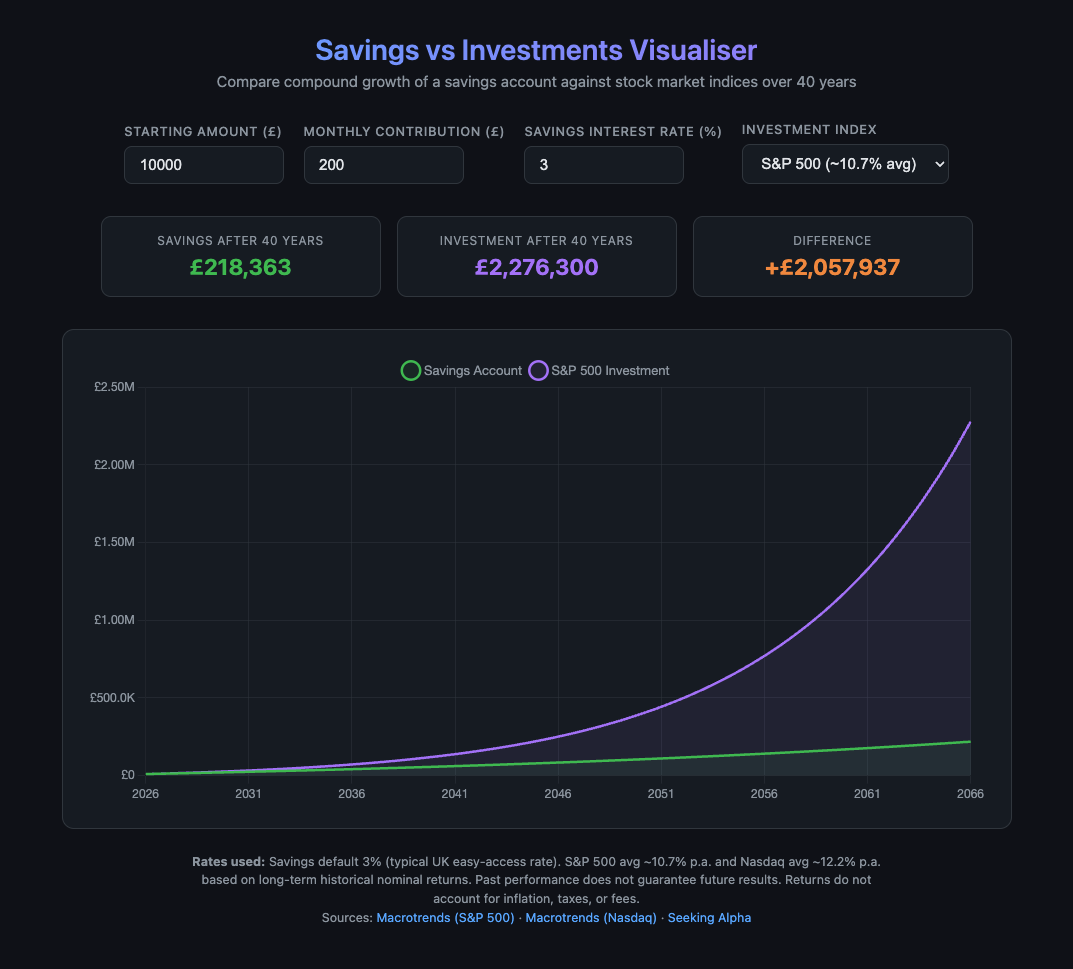
Savings vs. Investments Visualiser
with inputs for savings rate and investment index (S&P 500 or Nasdaq)
2026
LLM used: Anthropic Claude - Opus 4.6
Features:
- Inputs you can tweak: starting amount (default £10,000), monthly contribution (default £200), savings interest rate (default 3% — typical UK rate), and a dropdown to switch between S&P 500 and Nasdaq.
- Rates used (based on long-term historical averages): S&P 500 at ~10.7% p.a. and Nasdaq at ~12.2% p.a. These are nominal returns — the app includes a disclaimer that they don't account for inflation, taxes, or fees.
- The chart plots both lines from 2026 to 2066, with hover tooltips showing exact values for each year and the difference between savings and investment.
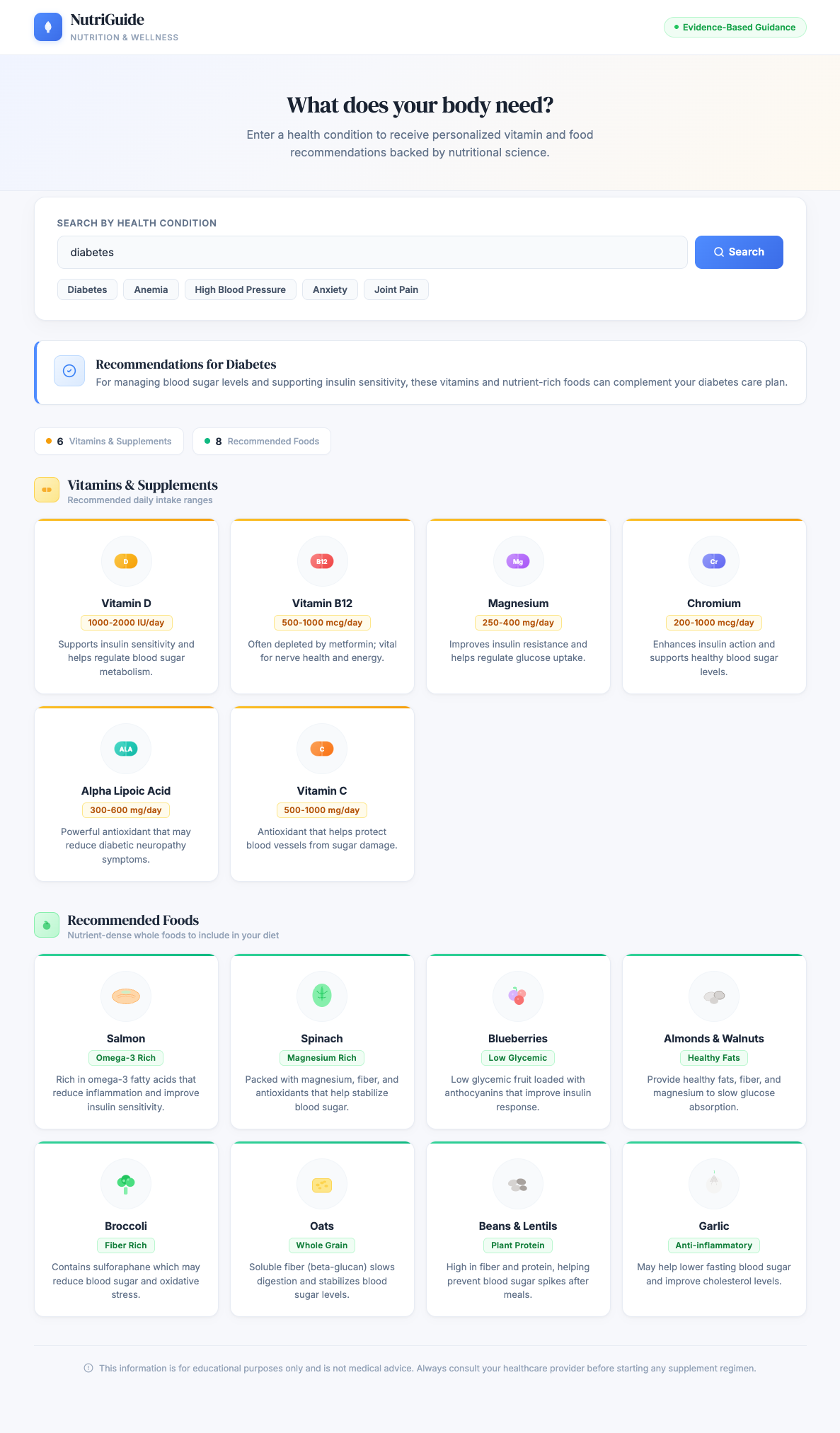
NutriGuide
Personalised vitamin and food recommendations based on health condition.
2026
LLM used: Anthropic Claude - Opus 4.6
Features:
- A search bar where users type a health condition, with 5 pre-built conditions — Diabetes (pre-selected), Anemia, High Blood Pressure, Anxiety, and Joint Pain. Each condition shows a curated grid of recommended vitamins with dosages and recommended foods with dietary tips.
Design System Token Explorer
Design System Playground.
2026
LLM used: Anthropic Claude - Opus 4.6
Features:
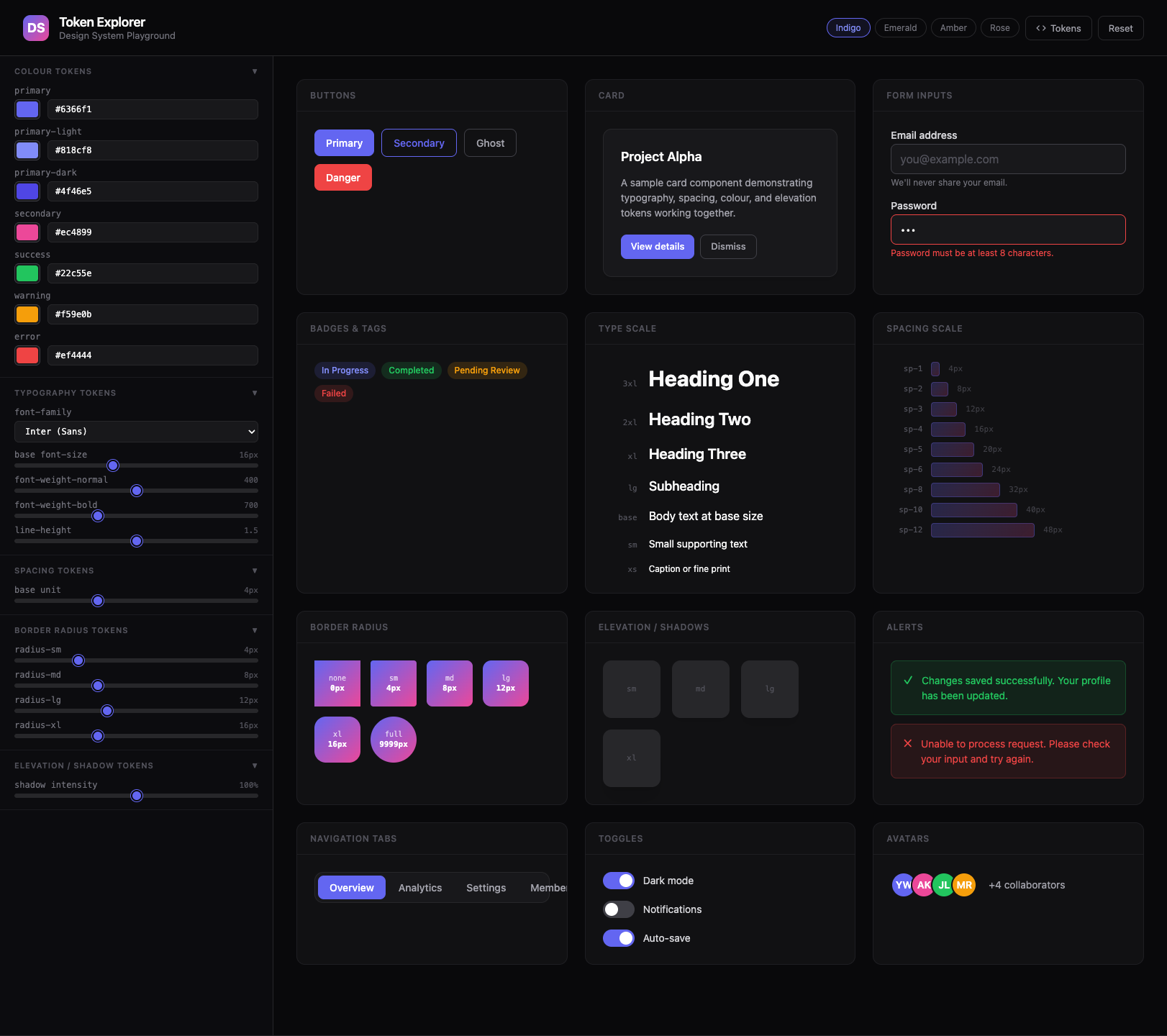
- Sidebar controls — tweak colour tokens (with swatch + hex input), typography (font family, base size with auto-scaling ratio, weight, line height), spacing (base unit that cascades through the whole scale), border radius (per-level sliders), and shadow intensity — all updating the live preview instantly.
- 12 sample components that respond to every token change: buttons (primary/secondary/ghost/danger), a card, form inputs with error states, badges, a type scale, spacing scale visualisation, radius preview, shadow/elevation boxes, alerts, tab navigation, toggles, and an avatar stack.
- 4 colour presets (Indigo, Emerald, Amber, Rose) for quick theme switching, a "Tokens" button that reveals the generated CSS custom properties you can copy straight into a codebase, and a reset button.
Contrast Checker
WCAG 2.1 Accessibility Compliance.
2026
LLM used: Anthropic Claude - Opus 4.6
Features:
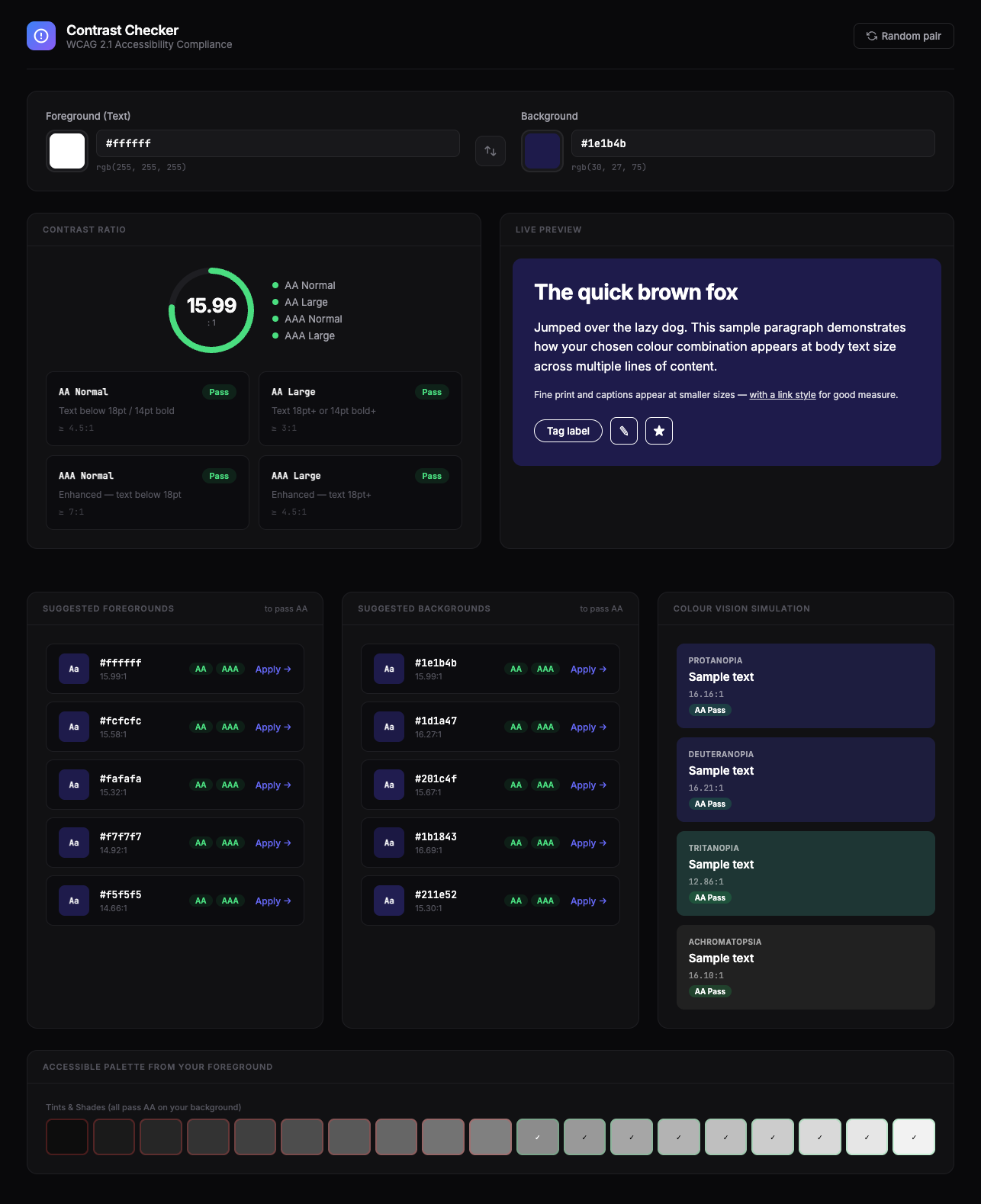
- Colour input — foreground and background pickers with hex fields, RGB readout, a swap button, and a "Random pair" generator that always produces an AA-passing combination.
- Contrast score ring — animated arc showing the ratio against the 21:1 maximum, colour-coded from red through amber to green. Alongside it, a summary showing pass/fail for all four WCAG 2.1 levels (AA Normal, AA Large, AAA Normal, AAA Large), each with the required ratio and a description of what text sizes it applies to.
- Live preview — your colour pair applied to a heading, body text, fine print, a link, chip tags, and icon buttons so you can judge readability across real component patterns.
- Smart suggestions — two panels generating the closest passing foreground and background alternatives by walking the lightness axis of your chosen hue. Each shows a swatch preview, the ratio, AA/AAA badges, and a one-click "Apply" action.
- Colour vision deficiency simulation — Protanopia, Deuteranopia, Tritanopia, and Achromatopsia simulations showing how your pair looks to people with each condition, with the simulated ratio and pass/fail badge.
- Accessible palette strip — a full tint/shade ramp of your foreground hue, with green/red borders indicating which values pass AA against your current background. Click any chip to apply it.
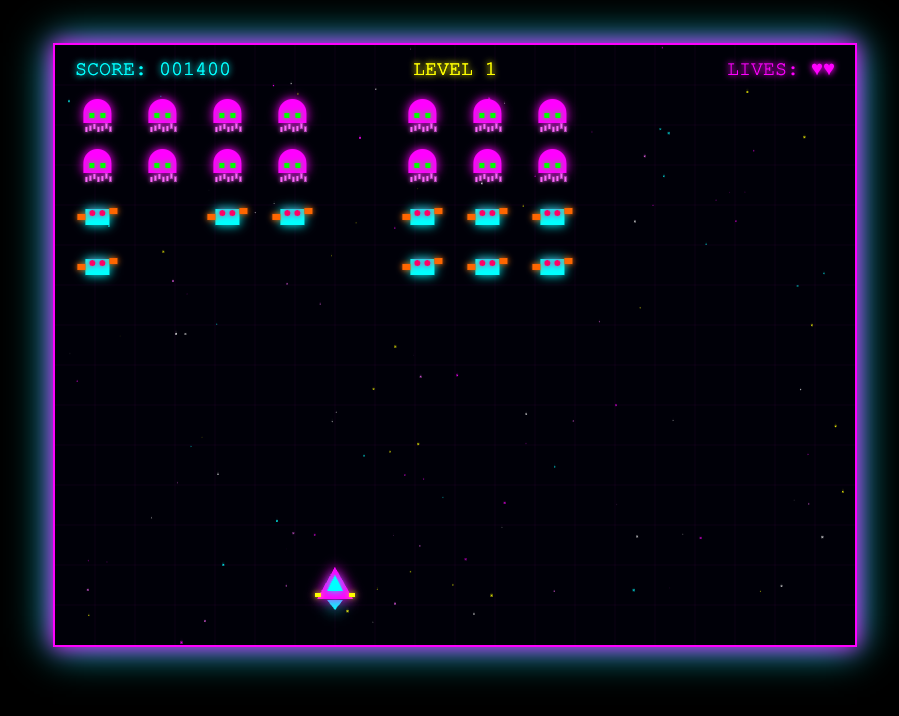
Neon Blaster
80's Space Shoot 'Em Up.
2026
LLM used: Anthropic Claude - Opus 4.6
Features:
- Controls: Arrow keys (or A/D) to move, Spacebar to fire lasers.
- Gameplay: Player's neon magenta ship sits at the bottom firing green laser bolts upward at a formation of aliens that sweep left-to-right and creep downward. Four alien types with distinct neon sprites — magenta squids with wiggling tentacles, cyan crabs with snapping claws, yellow diamond bugs with antennae, and red skull bosses. Each type is worth more points.
- 80's vibes: Scrolling starfield, neon glow effects on everything, retro grid lines, screen shake on explosions, particle bursts, and a CRT-style motion trail. The game has 10 progressively harder levels with faster aliens and more aggressive shooting. Lives, score, and level are displayed in the HUD.